Second IWRM Batch: BWDB Officials Trained on Water Policy 1999, Water Act 2013 & Water Resources Regulations 2018
Management and Training International (MTI) Ltd. conducted the second running of the three-day course on Integrated Water Resources Management (IWRM), focusing on the National Water Policy 1999, the Water Act 2013 and the Water Resources Regulations 2018, from 15 to 17 September 2026 at the Central ICT Lab, Level-11, Pani Bhaban, BWDB, Dhaka. Twenty-five officials of the Bangladesh Water Development Board (BWDB), under the Ministry of Water Resources, took part — the fifth batch under Package 21 of the Climate-Smart Agriculture and Water Management Project (CSAWM Project), BWDB Part.
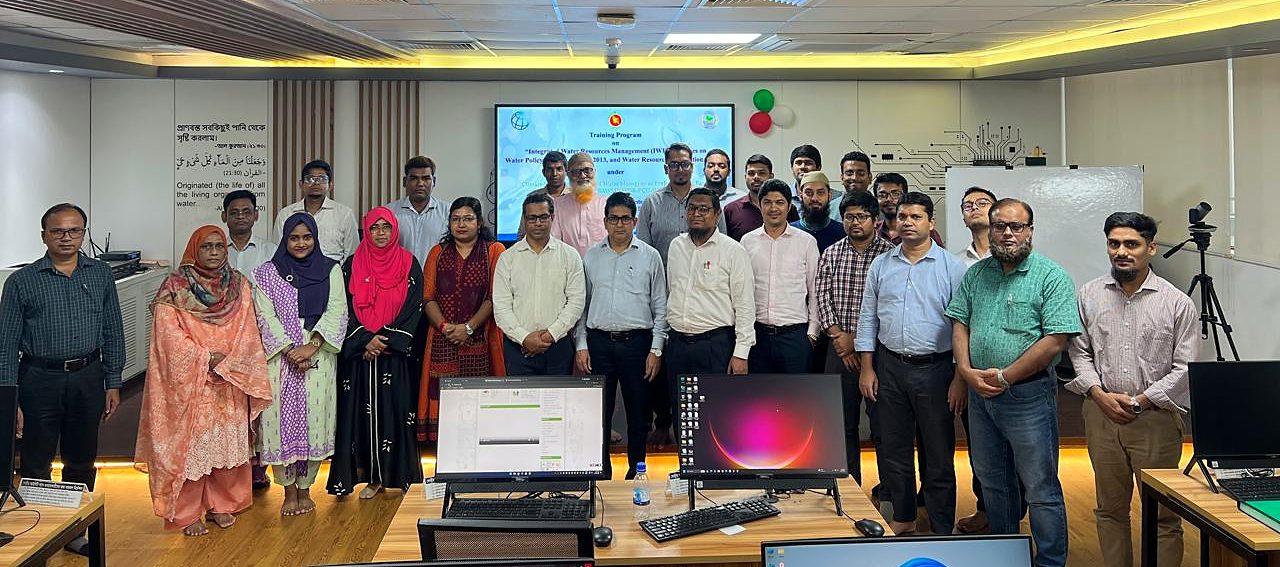
About the engagement: Under reference CSAWMP-WDB-PCU-WD-21-5-IWRM-02 (Course ID CSAWMP-WDB-PCU-WD-21/IWRM-02), MTI Ltd. is delivering the Package 21 training programme for the Climate-Smart Agriculture and Water Management Project (BWDB Part), implemented by the Bangladesh Water Development Board under the Ministry of Water Resources. The course was authorised by Office Order Memo Nos. 42.01.0000.000.647.25.0009.26-335 (course module) and 26-336 (participants), both dated 14 September 2026, following the Director General’s D-Nothi approval (Para 7.3) of 13 September 2026.
Same Laws, a Different Room
The first IWRM batch ran in June at the BWDB Training Institute in Bhagyakul, Munshiganj. This second running moved to Pani Bhaban, to a cohort weighted much more heavily towards senior engineers: six Executive Engineers and five Sub-Divisional Engineers, most of them from the design circles that turn policy into drawings. The legal spine of the course did not change — the National Water Policy 1999, the National Water Management Plan 2001, the participatory framework of 2000 and 2014, the BWDB Act 2000, and the Water Act 2013 with its 2018 Regulations — but the questions it was asked did.
For a design engineer the useful question about the Water Act is not “what does it say” but “what does it require of the scheme I am drawing” — licensing of abstraction, environmental safeguards in dredging and construction, the inspection and reporting that will follow. The course was organised to arrive there: principles on Day 1, the institutions that apply them on Day 2, and the law that enforces them on Day 3, closing with an integration and action-planning session in which groups applied all three to a case.
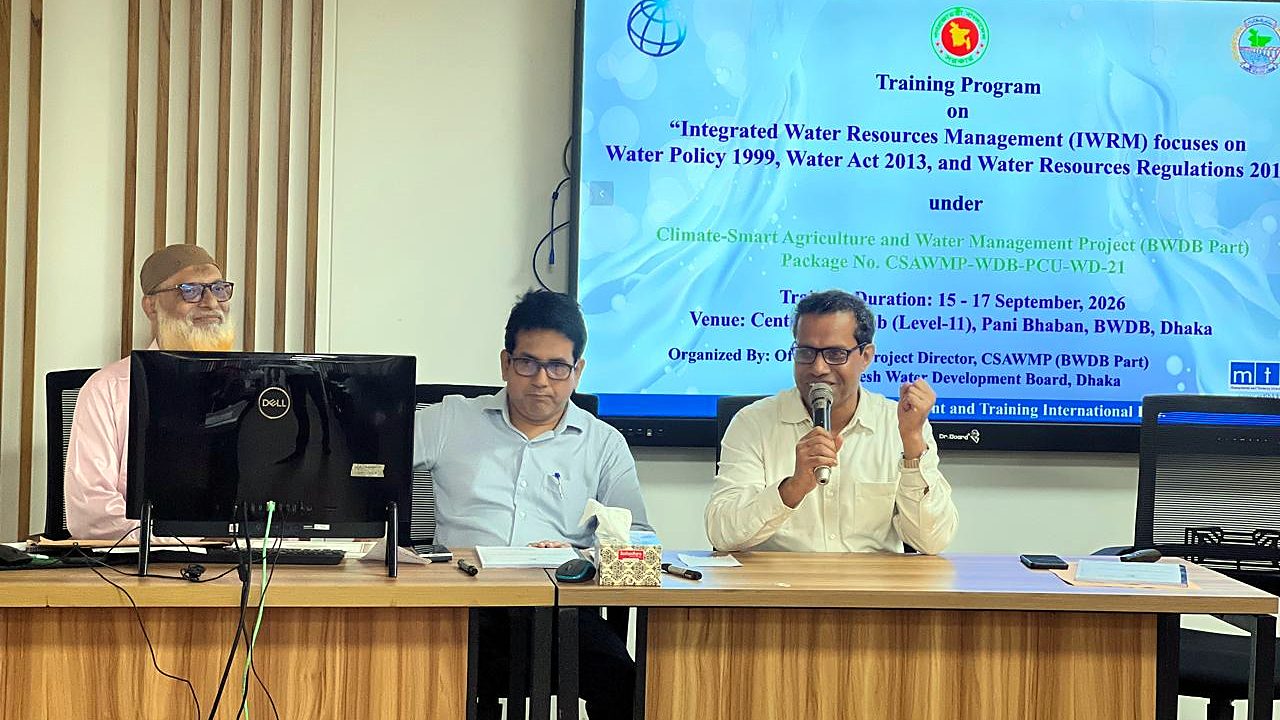
Resource Persons
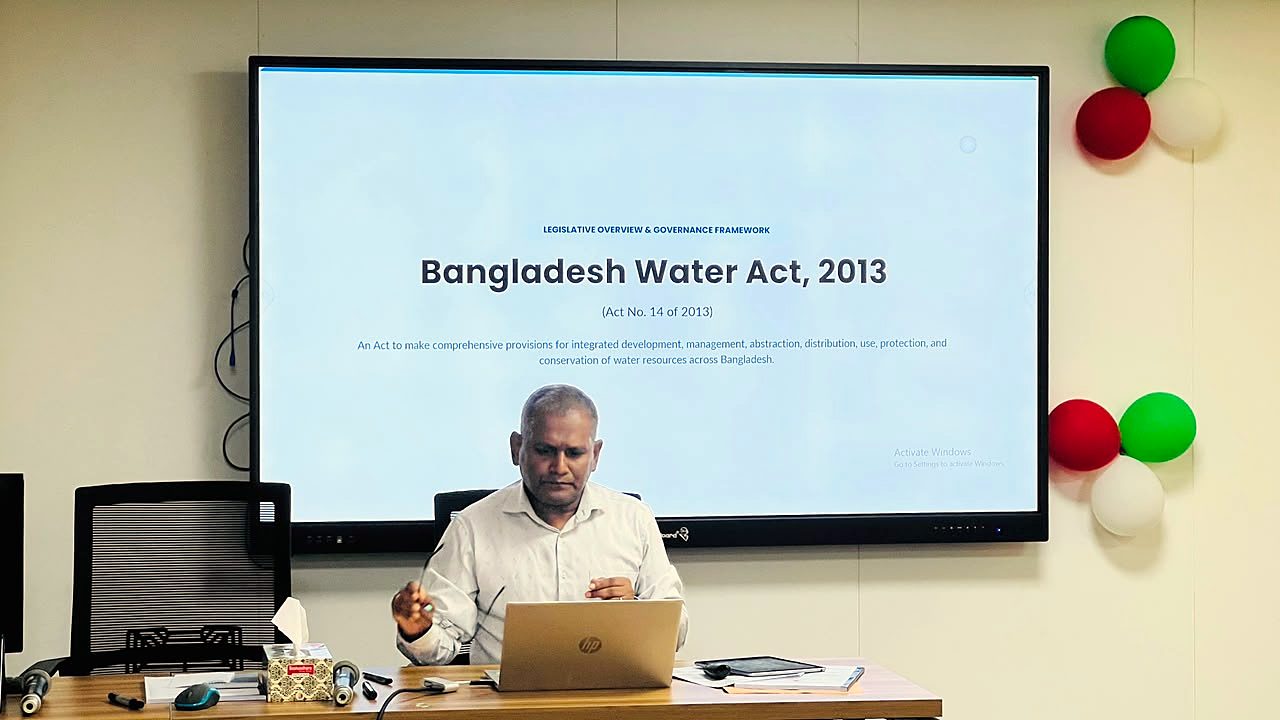
Eight resource persons delivered the twelve sessions. Dr. Robin Kumar Biswas, Additional Chief Engineer in the Office of the Chief Engineer, Planning, carried the backbone of the course — IWRM principles and fundamentals on Day 1, and the Water Act and Water Resources Regulations on Day 3. Three Deputy Chief Extension Officers took the participatory framework, two Superintending Engineers of the CSAWM and B-Strong projects took the BWDB Act, integration and review, and the Directorate of Planning-1 took national policy and planning.
Additional Chief Engineer (Civil) & Project Director
CSAWM Project (BWDB Part)
Additional Chief Engineer (Civil)
Office of the Chief Engineer, Planning
Superintending Engineer (Civil)
Directorate of Planning-1, BWDB
Deputy Chief Extension Officer (CD)
Office of the Addl. Chief Engineer, Central Zone
Deputy Chief Extension Officer (CD)
CSAWM Project (BWDB Part)
Superintending Engineer (Civil)
CSAWM Project (BWDB Part)
Deputy Chief Extension Officer (CD)
Office of the DCEO (CD), Dhaka
Superintending Engineer (Civil)
B-Strong Project (BWDB Part)
Course Leadership
Executive Engineer (Civil)
CSAWM Project (BWDB Part)
Sub-Divisional Engineer
CSAWM Project (BWDB Part)
Executive Engineer (Civil)
CSAWM Project (BWDB Part)
Managing Director
Management and Training International Ltd.
The Legal and Policy Stack, in Order
The twelve sessions climb the stack of instruments that governs water in Bangladesh, from principle to enforceable rule.
National Water Policy
The policy basis: priority sectors and how small-scale projects, irrigation and flood control align with national goals.
Participatory Water Management Guidelines
WMO structure, community participation and local knowledge, and community-based operation and maintenance.
Bangladesh Water Development Board Act
The Board’s authority and governance, project approval and execution, and coordination with other agencies.
National Water Management Plan
National and regional planning, and how field projects connect to it.
Bangladesh Water Act
Water rights and licensing, regulatory provisions, abstraction control and compliance.
Participatory Water Management Rules
WMO governance and accountability, formalised in rules applied in the field.
Water Resources Regulations (and 2019 Guidelines)
Applying the regulations in implementation; safeguards in dredging and construction; inspection and reporting.
Integration & Action Planning
Applying the whole stack to a case, and drafting IWRM-based proposals and improvements to ongoing projects.
Day-by-Day Course Schedule
Participants reported to the Central ICT Lab at 08:30 on the first morning and at 09:00 on the following two days. Each day ran four sessions and closed at 16:00.
- 08:30–09:20 Inauguration of the Training Course Registration and breakfast; introduction of participants; objectives and detailed agenda; participants’ expectations; pre-evaluation; a brief introduction to the CSAWM Project (BWDB Part). Methods: self-introduction, questionnaire, lecture discussion. Pijush Krishna Kundu Project Director, CSAWM Project (BWDB Part), with the course management team
- 09:20–10:40 Session 1 — Principles and Practices of IWRM Defining IWRM and why it matters; the key components of water, land and people; IWRM challenges in the Bangladesh context; multi-purpose use of canals and rivers. Methods: speech, game, large group discussion. Dr. Robin Kumar Biswas Additional Chief Engineer (Civil), Office of the Chief Engineer, Planning, BWDB
- 10:40–10:50 Refreshment and tea break
- 10:50–12:10 Session 2 — Fundamentals of IWRM Core IWRM principles and how they relate to fieldwork; identifying trade-offs between water uses; designing fair water distribution and managing limited water resources. Methods: Q&A, large group discussion. Dr. Robin Kumar Biswas Additional Chief Engineer (Civil), Office of the Chief Engineer, Planning, BWDB
- 12:10–13:30 Session 3 — National Water Policy 1999 Policy basics and priority sectors; linking policy to engineering work; aligning small-scale projects with policy goals and supporting irrigation and flood-control priorities. Methods: VIPP, large group discussion. Dr. Md. Khairul Islam Superintending Engineer (Civil), Directorate of Planning-1, BWDB
- 13:30–14:20 Lunch and prayer break
- 14:20–15:40 Session 4 — National Water Management Plan 2001 National planning concepts, regional differences and project relevance; supporting project planning at field level and understanding regional water challenges. Methods: Q&A, large group discussion. Dr. Md. Khairul Islam Superintending Engineer (Civil), Directorate of Planning-1, BWDB
- 15:40–16:00 Day review and refreshment
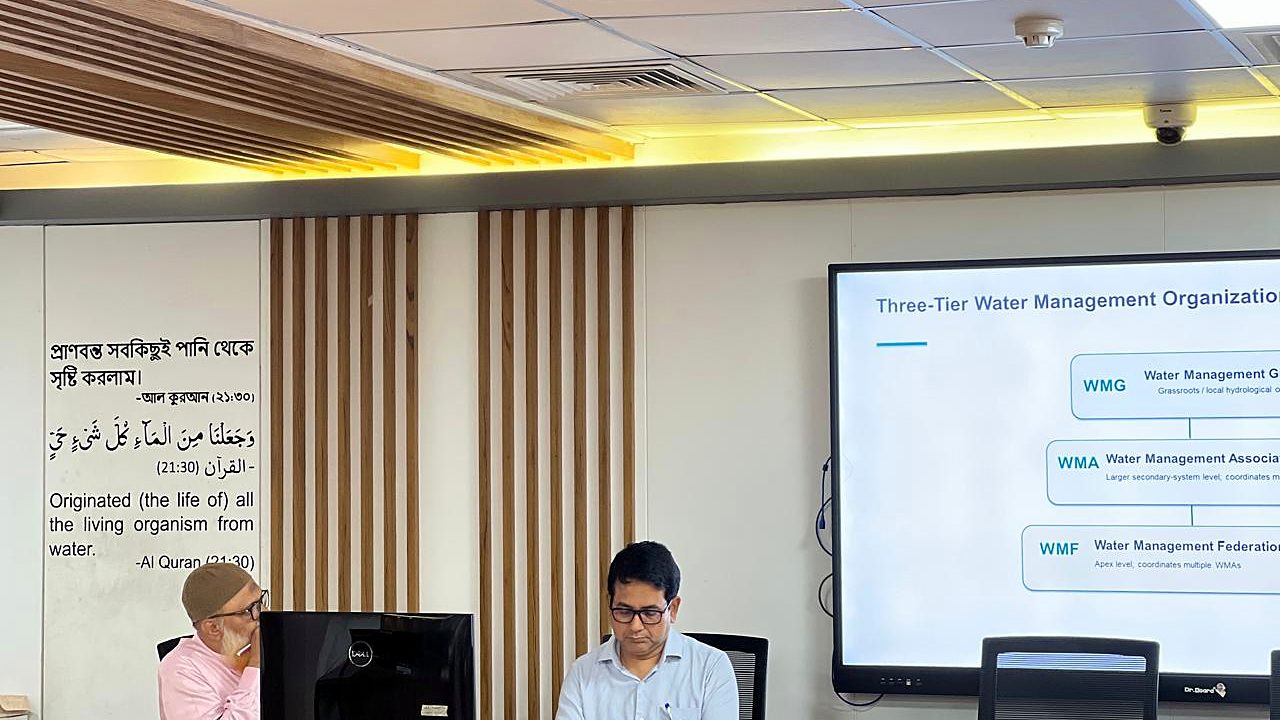
- 09:00–10:20 Session 1 — Guidelines for Participatory Water Management 2000 Recapitulation of Day 1; the structure of Water Management Organisations; facilitating community participation and integrating local knowledge; establishing Water Management Groups and community-based operation and maintenance. Methods: interactive discussion, brainstorming. Dr. Md. Zahidul Islam Deputy Chief Extension Officer (CD), Office of the Additional Chief Engineer, Central Zone
- 10:20–10:40 Refreshment and tea break
- 10:40–12:00 Session 2 — Participatory Water Management Rules 2014 Applying the rules in field practice; strengthening WMO governance and accountability; formalising WMO activities and monitoring community participation. Methods: large group discussion with PPP. Md. Hafizur Rahman Deputy Chief Extension Officer (CD), CSAWM Project (BWDB Part)
- 12:00–13:20 Session 3 — Bangladesh Water Development Board Act 2000 The Board’s institutional authority, legal compliance and governance; project approval and execution; coordination with other agencies. Methods: plenary discussion, large group discussion. Md. Sultan Mahmud Superintending Engineer (Civil), CSAWM Project (BWDB Part)
- 13:20–14:20 Lunch and prayer break
- 14:20–15:40 Session 4 — Participatory Planning and Stakeholder Engagement Stakeholder analysis, facilitating participatory planning and managing conflict; stakeholder consultation in embankment projects and conflict resolution in water allocation. Methods: Q&A, large group discussion, case study. Muhammad Monirul Alam Sarker Deputy Chief Extension Officer (CD), Office of the DCEO (CD), Dhaka
- 15:40–16:00 Day review and refreshment
- 09:00–10:20 Session 1 — Water Act 2013 Recapitulation of Day 2; water rights and licensing; applying regulatory provisions and preventing misuse; regulating water abstraction and ensuring compliance in projects. Methods: open discussion, small group work. Dr. Robin Kumar Biswas Additional Chief Engineer (Civil), Office of the Chief Engineer, Planning, BWDB
- 10:20–10:40 Refreshment and tea break
- 10:40–12:00 Session 2 — Water Resources Regulations 2018 & Guidelines 2019 Applying the regulations in project implementation; monitoring compliance and environmental safeguards; compliance in dredging and construction; field inspection and reporting. Methods: interactive discussion, Q&A, VIPP. Dr. Robin Kumar Biswas Additional Chief Engineer (Civil), Office of the Chief Engineer, Planning, BWDB
- 12:00–13:20 Session 3 — Integration, Case Study & Action Planning Applying integrated knowledge to real problems; developing actionable plans; preparing IWRM-based project proposals and improving ongoing BWDB projects. Methods: case study, group work. Abu Sale Mohammad Tofahel Chowdhury Superintending Engineer (Civil), B-Strong Project (BWDB Part)
- 13:20–14:20 Lunch and prayer break
- 14:20–15:40 Session 4 — Review of the Training Course A structured review of the three days, with participant groups presenting the key learnings from each day. Methods: group presentation, large group discussion. Md. Sultan Mahmud Superintending Engineer (Civil), CSAWM Project (BWDB Part)
- 15:40–16:00 Closing ceremony — post-evaluation, course evaluation and certificate distribution Pijush Krishna Kundu Project Director, CSAWM Project (BWDB Part), with the course management team
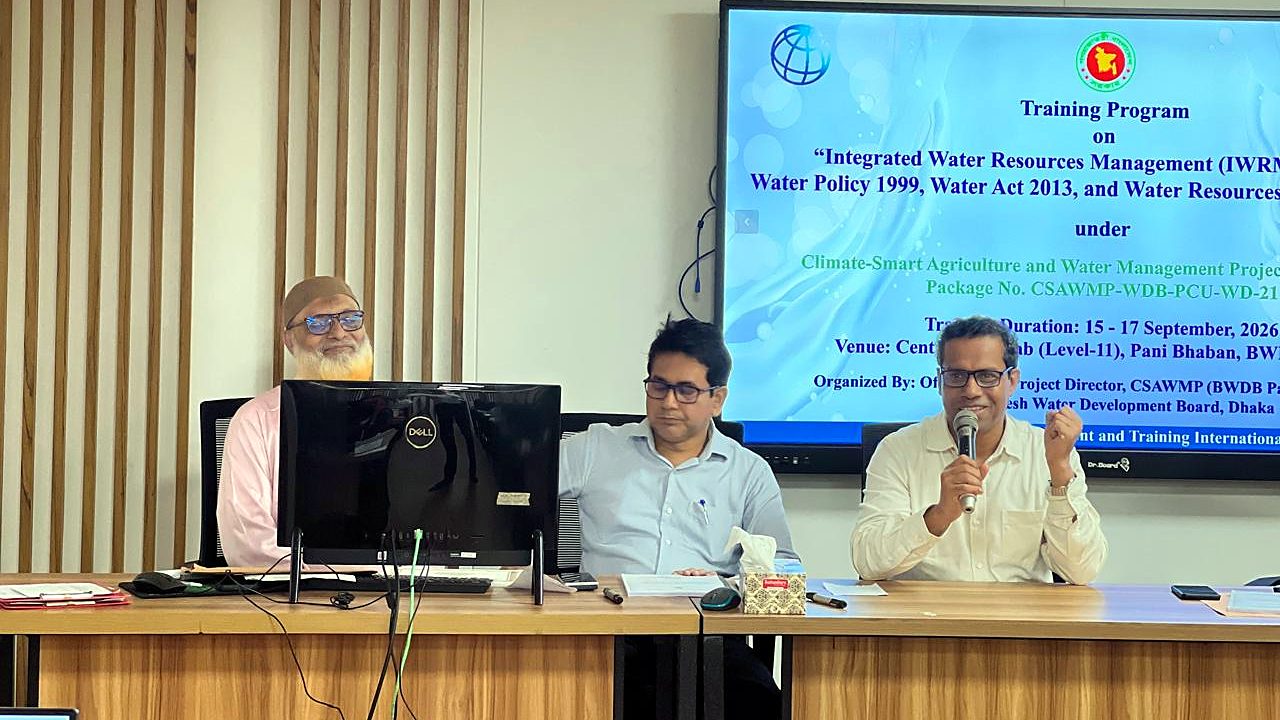
Training Methodology
Each session combined a short presentation with a participatory method. Day 1 opened with a game, the policy session used VIPP cards, the stakeholder session worked through a case study, and the Water Act was taught through open discussion and small group work. Every day began with a recap of the day before.
Group Presentations
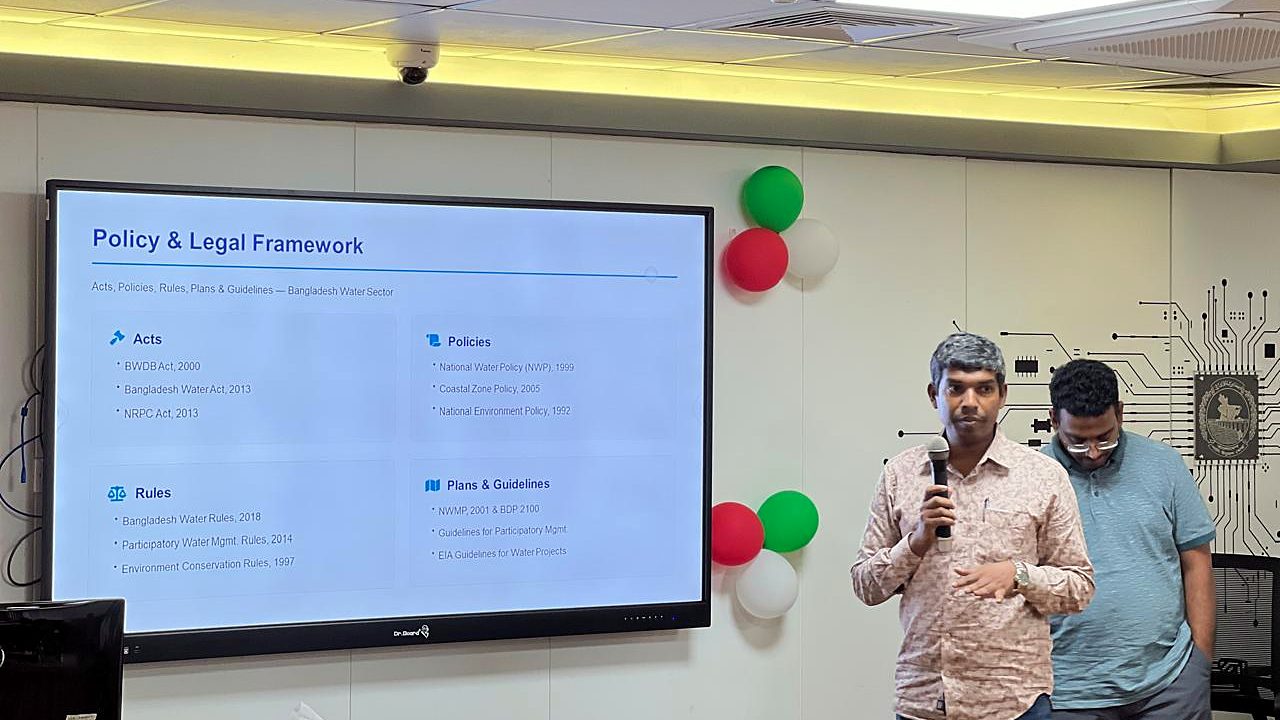
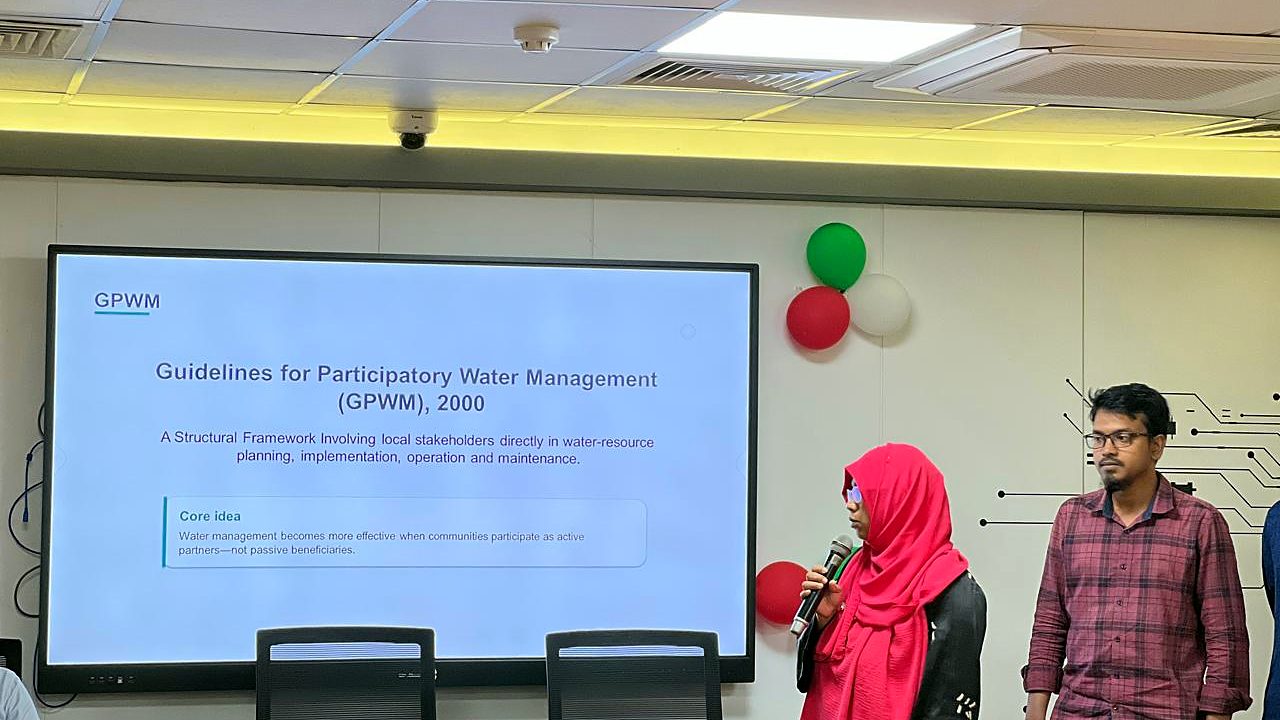
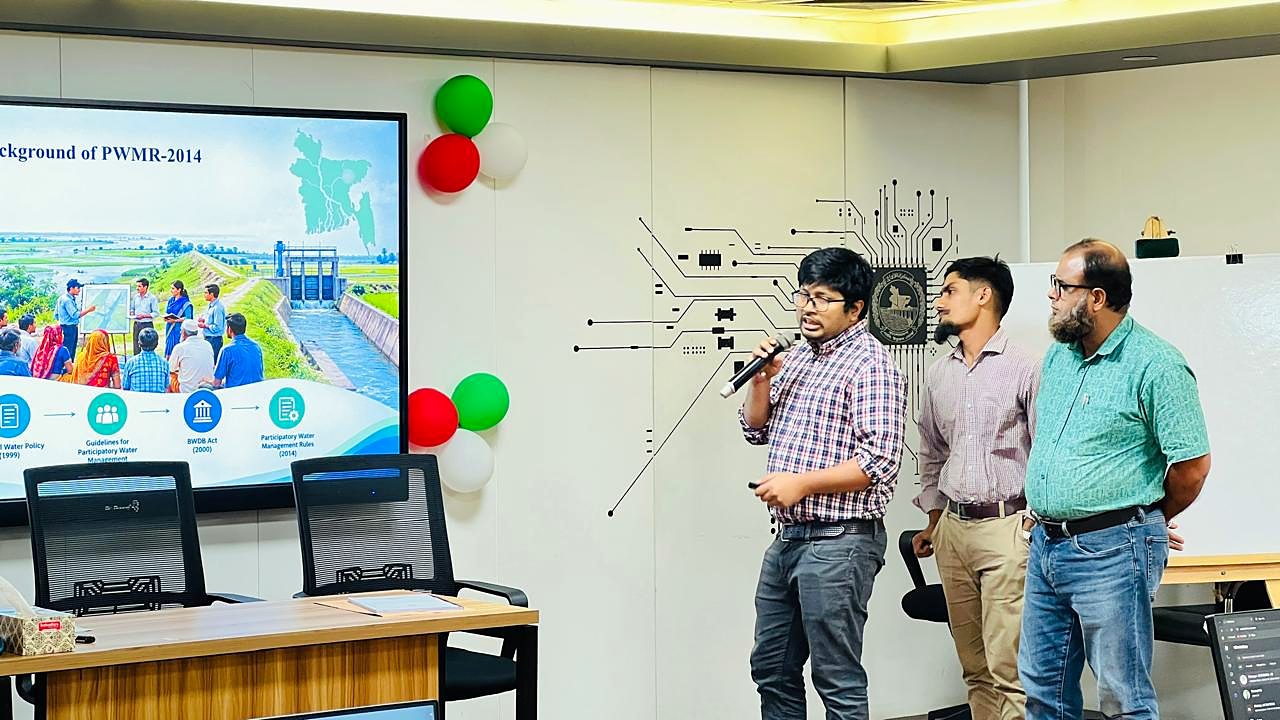
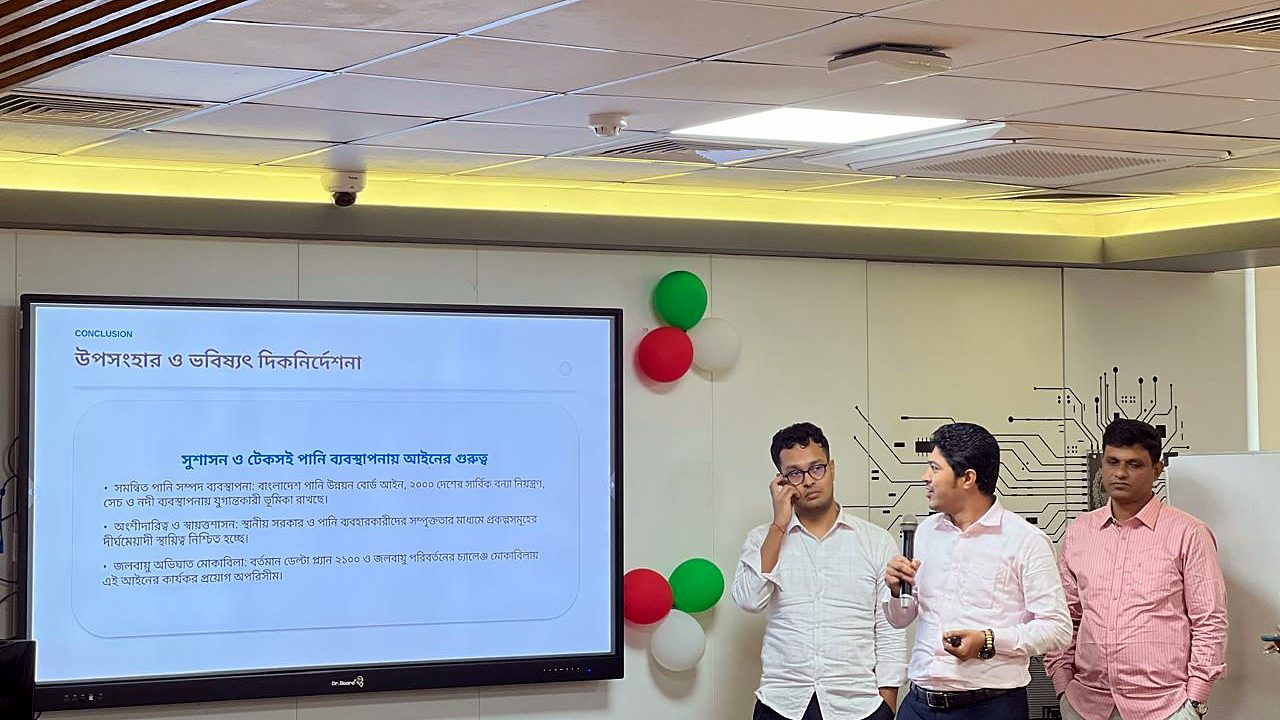
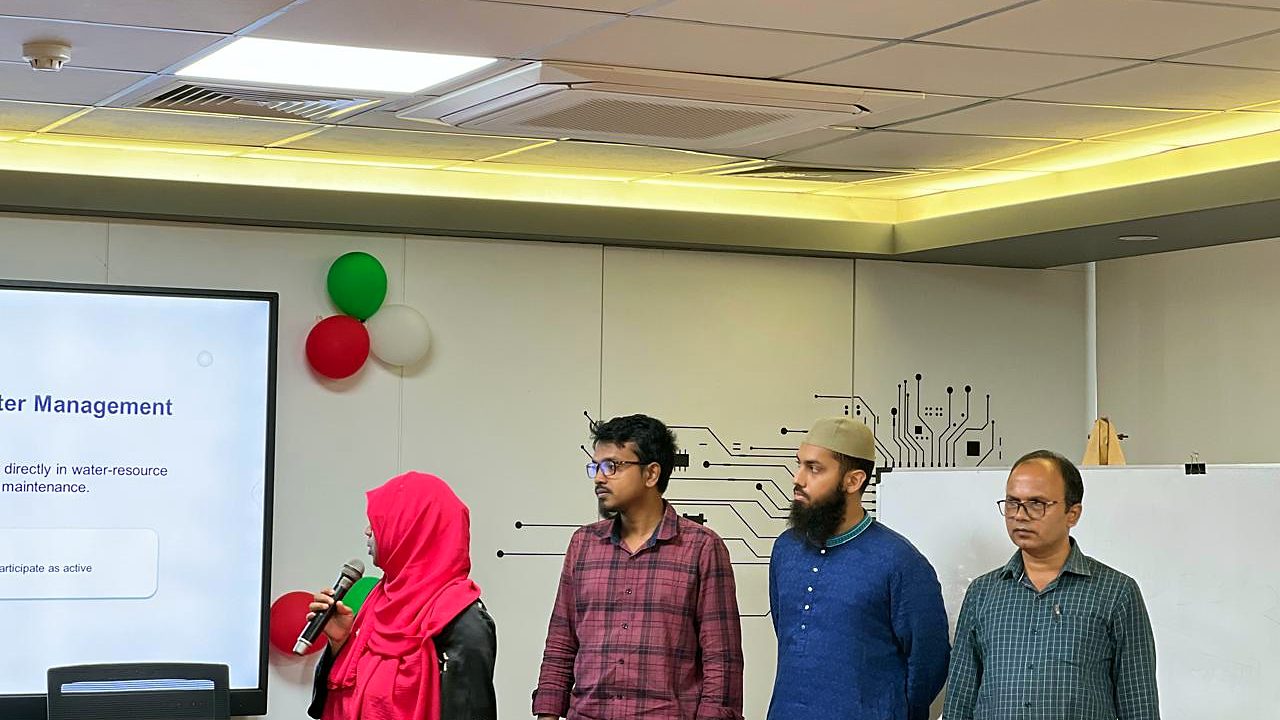
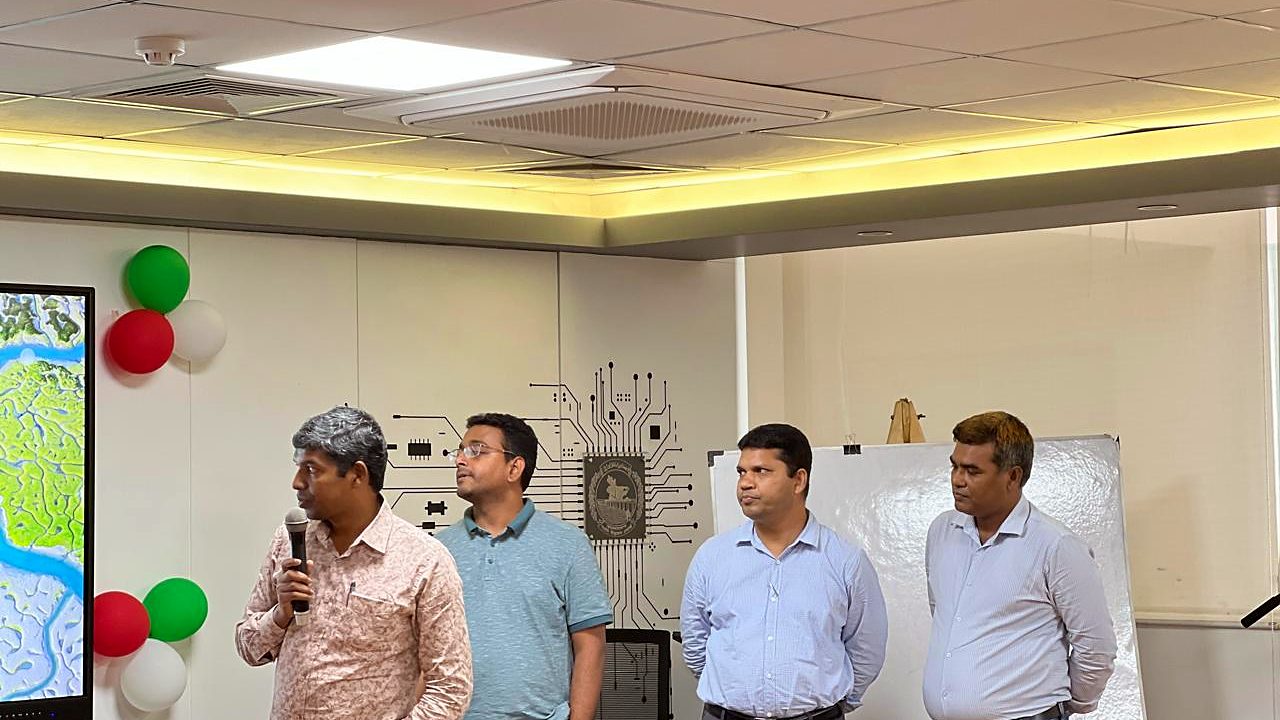
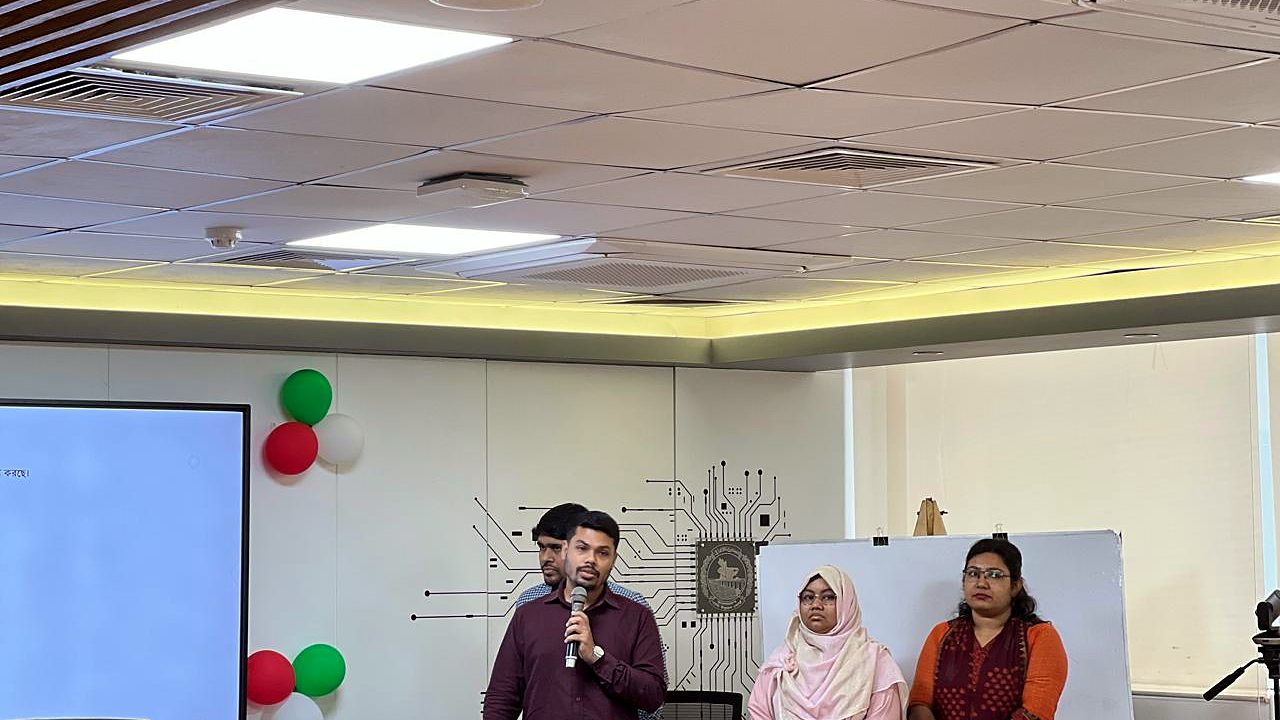
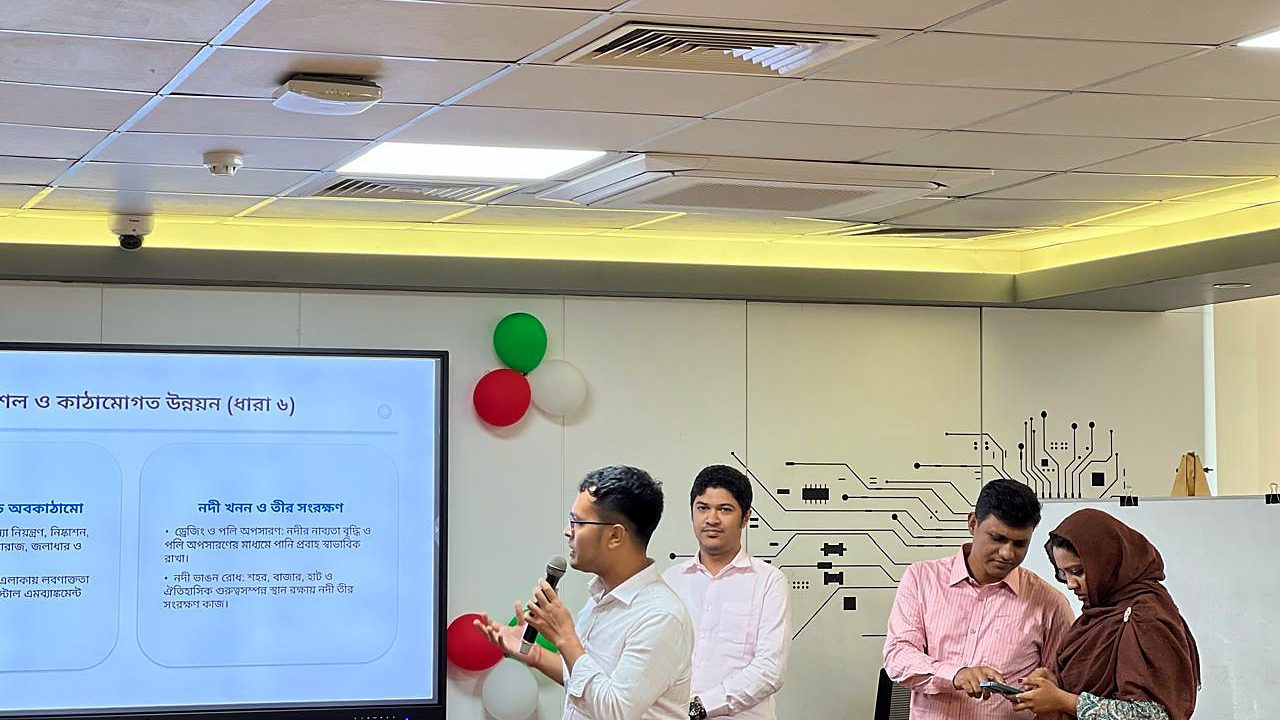
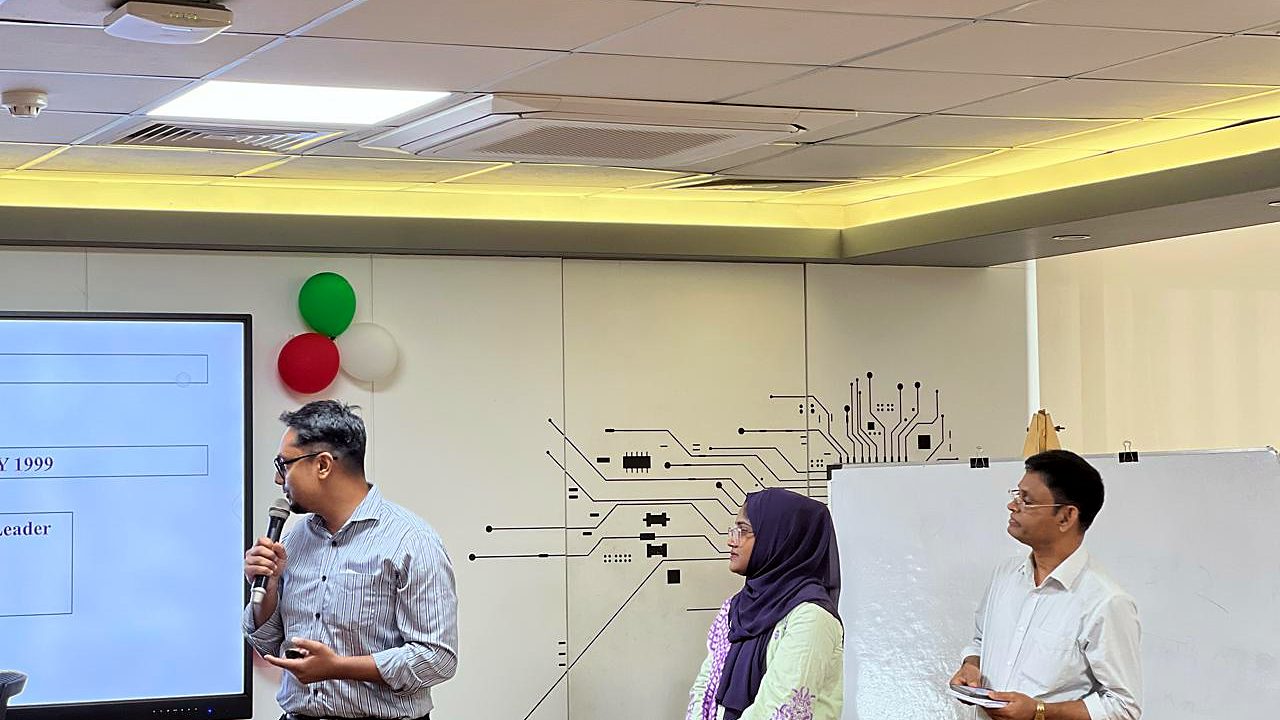
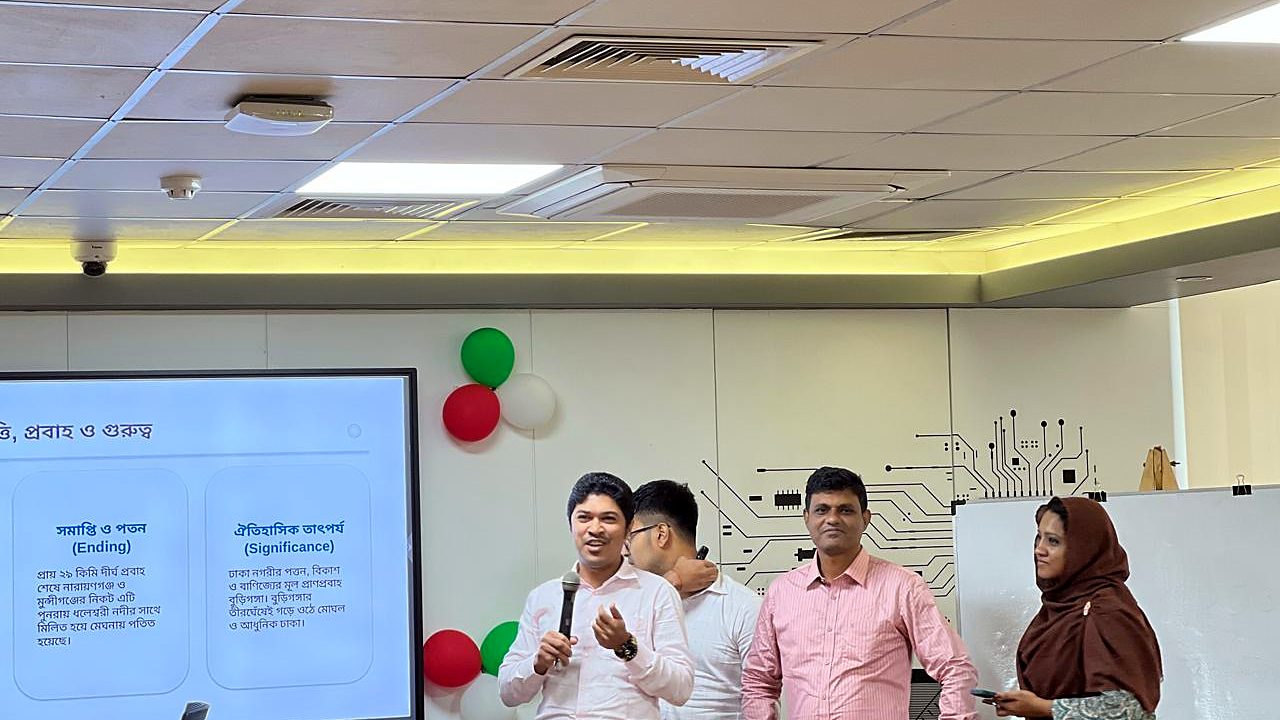
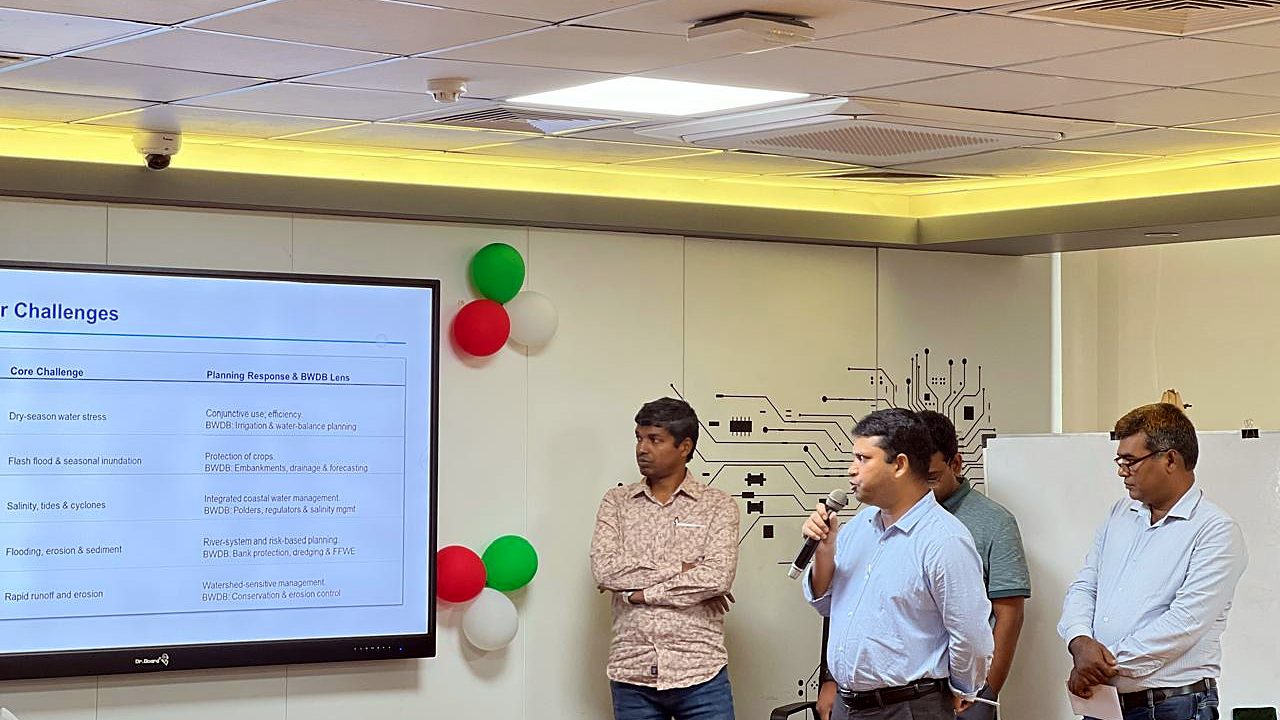
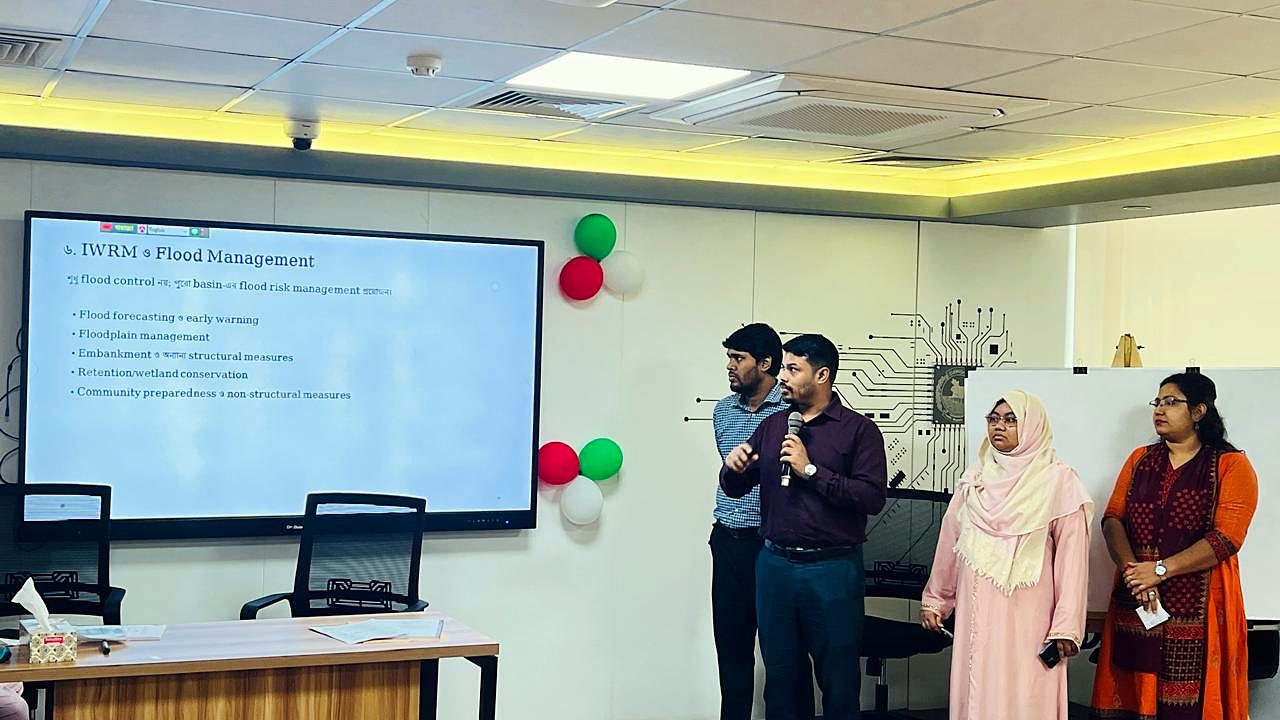
The final afternoon belonged to the participants. Groups presented back what they had taken from each instrument — the policy and legal framework, the 2000 Guidelines for Participatory Water Management, the historical background of the PWM Rules 2014 — with their own slides on the lab screen.
Who Was in the Room
Sixteen of the twenty-five participants were engineers: six Executive Engineers, five Sub-Divisional Engineers and five Assistant Engineers. Five of them came from Design Circle-7 alone (including its Design & Research wing), with others from Design Circles 3, 5 and 6, the Offices of the Chief Engineer for Planning and for Monitoring, the Office of the Director General and the Joint Rivers Commission. A Deputy Chief Extension Officer, a Research Officer, an Assistant Director, two Sub-Assistant Engineers and four accounts staff completed the cohort. Every participant was based in Dhaka.
Full Participant Roster
Executive Engineer (Civil)
Design Circle-7, BWDB, DhakaExecutive Engineer (Civil)
Office of the Director General, BWDB, DhakaExecutive Engineer (Civil)
Design Circle-5, BWDB, DhakaExecutive Engineer (Civil)
Design Circle-7, BWDB, DhakaExecutive Engineer (Civil)
Design Circle-3, BWDB, DhakaExecutive Engineer (Civil)
Office of the Chief Engineer, Monitoring, BWDB, DhakaDeputy Chief Extension officer (DCEO)
Office of the PEO, BWDB, DhakaSub-Divisional Engineer (Civil)
Joint Rivers Commission, BangladeshSub-Divisional Engineer (Civil)
Design & Research Circle-7, BWDB, DhakaSub-Divisional Engineer (Civil)
North Eastern Hydrology Measurement Division, BWDB, DhakaSub-Divisional Engineer (Civil)
Design Circle-7, BWDB, DhakaSub-Divisional Engineer (Civil)
Directorate Of Programme, BWDB, DhakaAssistant Director (Admin)
Directorate of Ground Water Hydrology, BWDB, DhakaResearch Officer (Sociology)
Directorate of Economic Evaluation, BWDB, DhakaAssistant Engineer (Civil)
Design Circle-7, BWDB, DhakaAssistant Engineer (Civil)
Design Circle-6, BWDB, DhakaAssistant Engineer (Civil)
Directorate of Human Resource Development, BWDB, DhakaAssistant Engineer (Civil)
Office of the Chief Engineer, Planning, BWDB, DhakaAssistant Engineer (Civil)
Directorate Of Programme, BWDB, DhakaSub-Assistant Engineer (Civil)
CSAWM (BWDB Part) Project, BWDB, DhakaSub-Assistant Engineer (M/E)
Construction & Instrumentation Division, BWDB, DhakaAssistant Accountant
Trustee Board, BWDB, DhakaSenior Accounts Assistant (SAA)
Focal Unit, Adaptive River System Management Project (ARSMP), BWDB, DhakaSenior Accounts Assistant (SAA)
Greenroad RAC, BWDB, DhakaSenior Accounts Assistant (SAA)
Greenroad RAC, BWDB, DhakaContinuity across the programme: 8 participants had already attended an earlier course in the series — among them Bilasi Akter, Farzana Afsari and Zulfikar Ali from the O&M batch two weeks earlier, and Mehadi Hasan and Samnun Yasir from the Financial Management batch. The traffic runs both ways: Md. Manzur Rahman, Executive Engineer in the Office of the Director General, who teaches the GIS and IoT day of the Package 22 Climate-Smart Agriculture and Water Management course (in July and again in October), sat this course as a participant.
Closing Ceremony & Certification
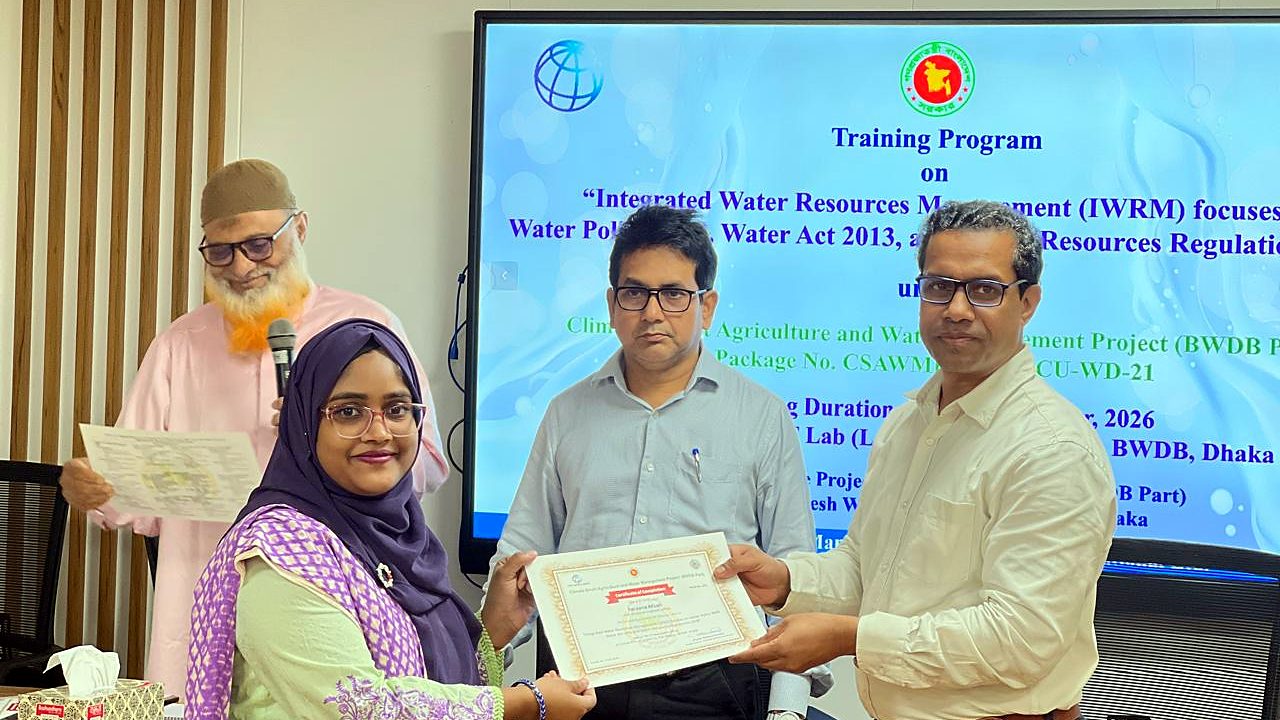
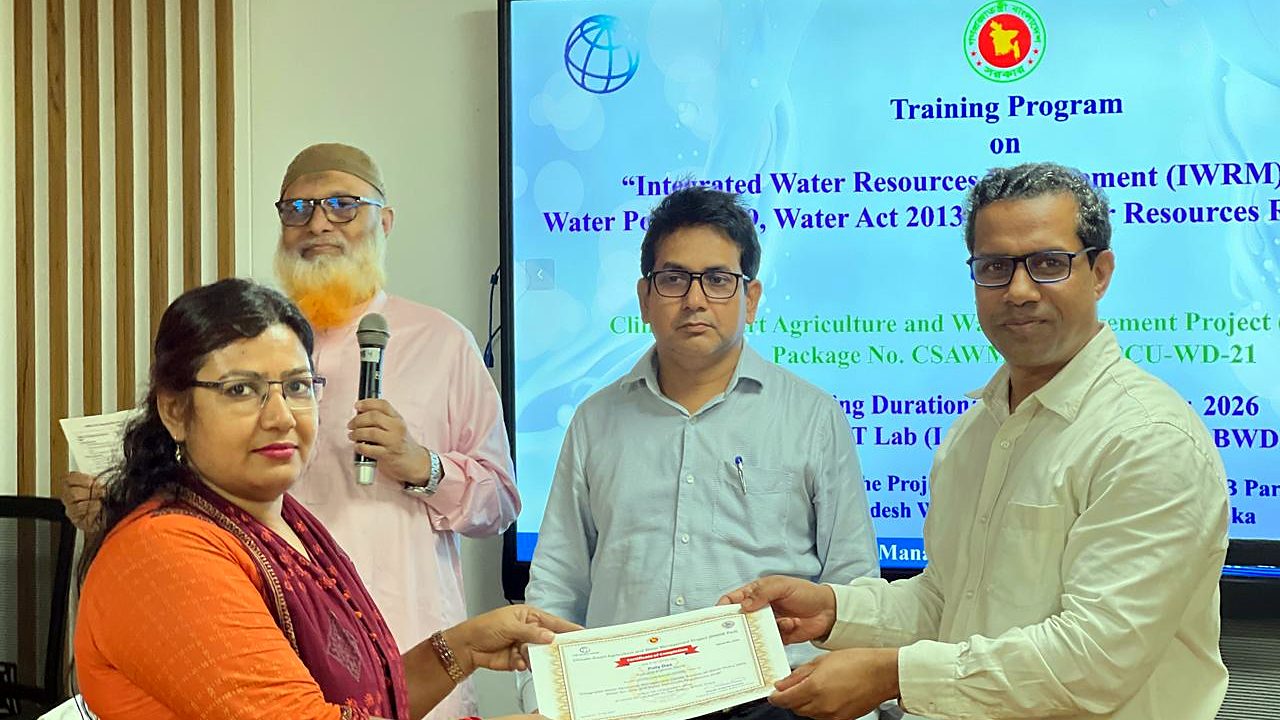
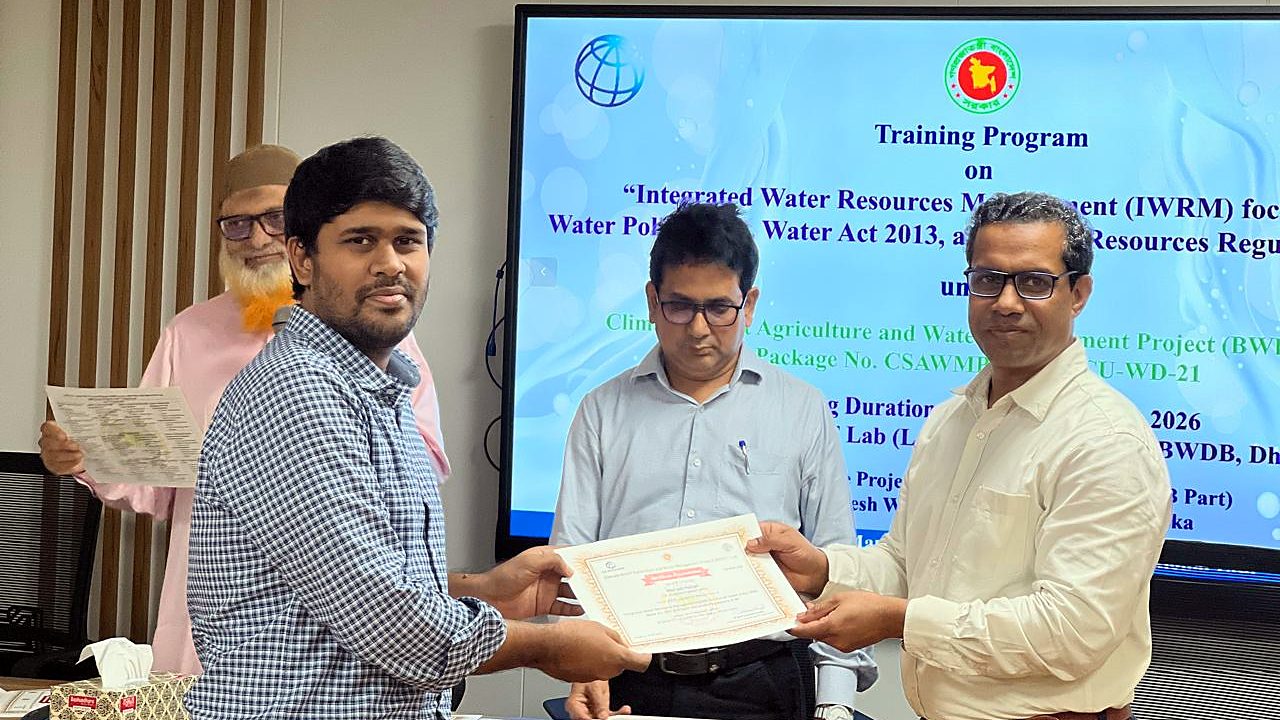
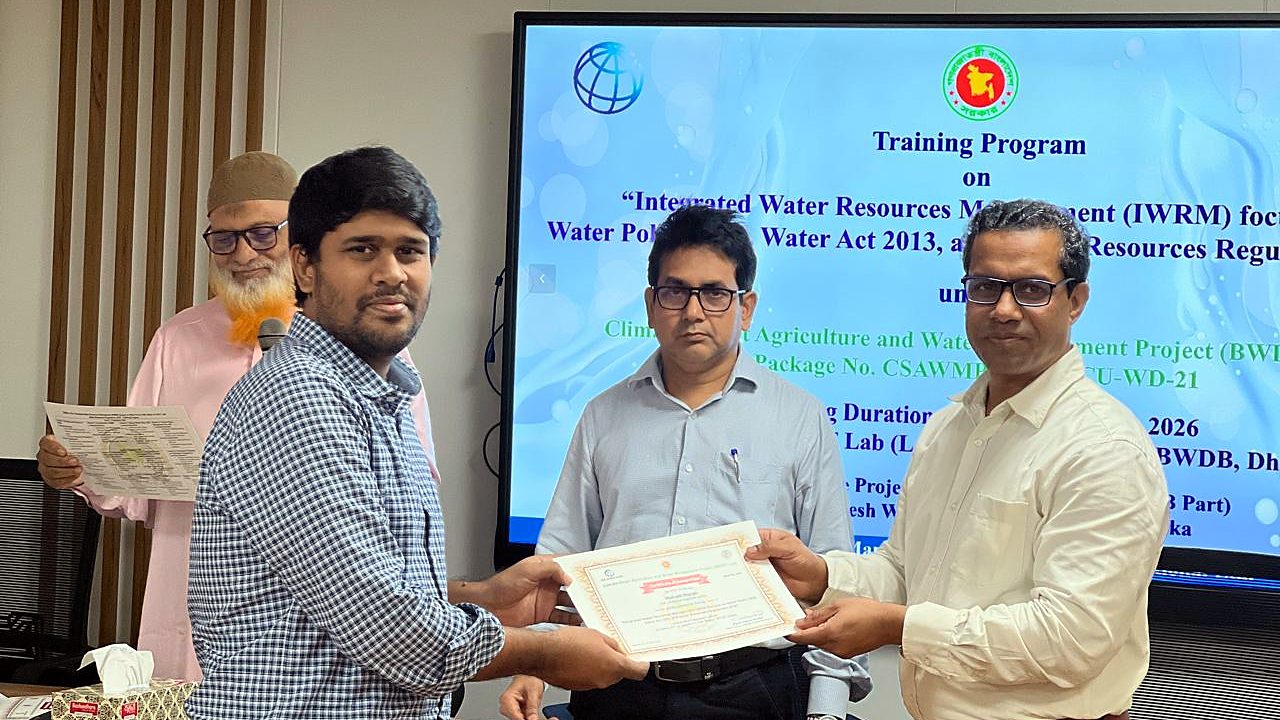
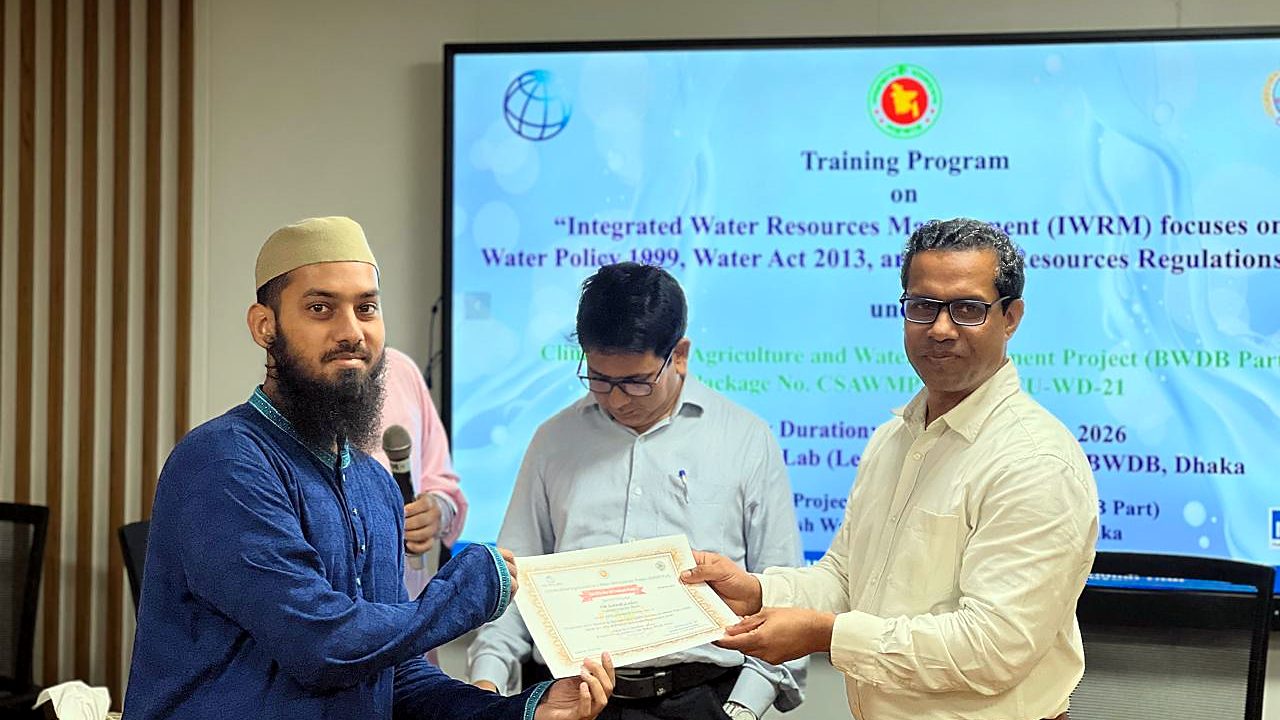
The Project Director closed the course on the afternoon of 17 September 2026. After the post-evaluation and course evaluation, certificates were handed to the participants at the dais.
The Course in Pictures
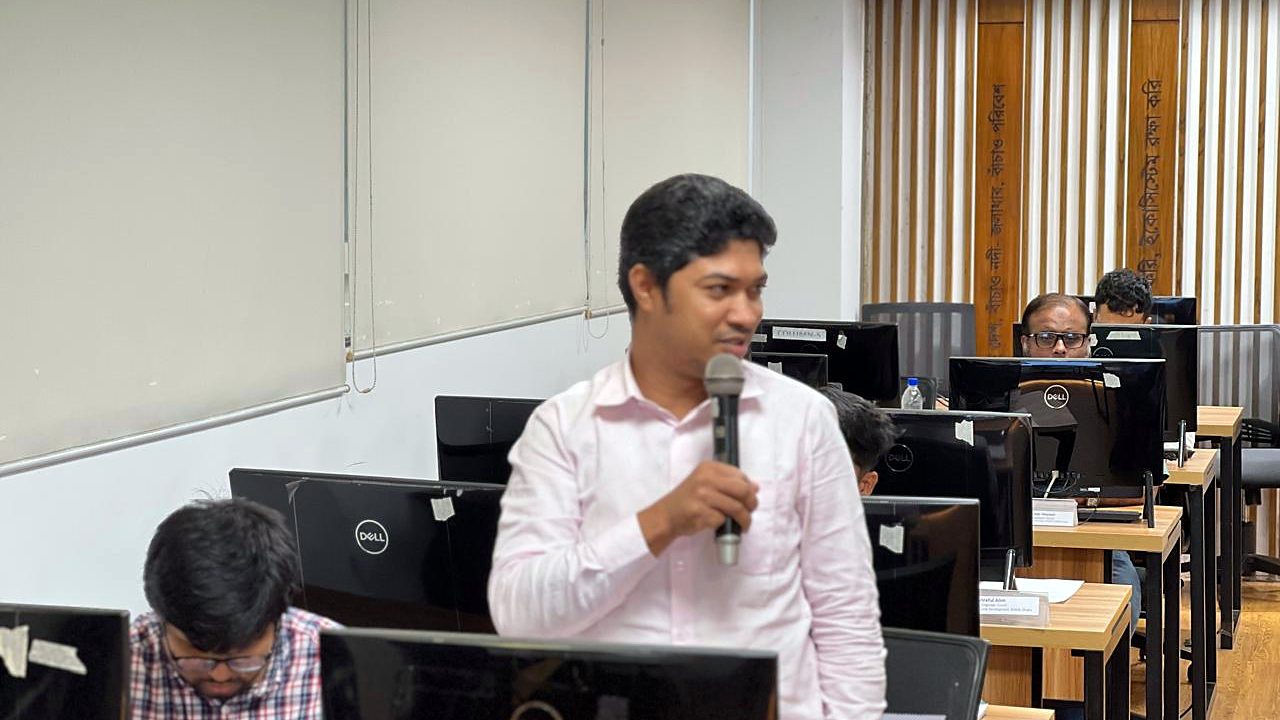
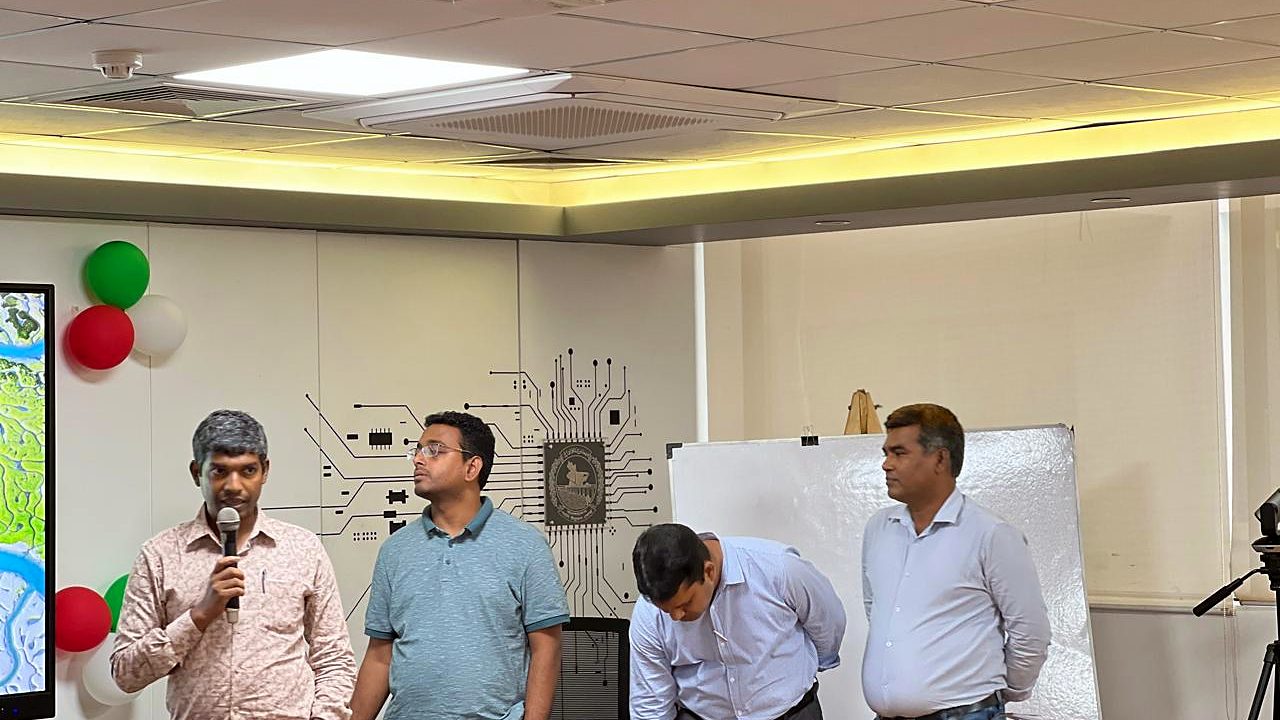
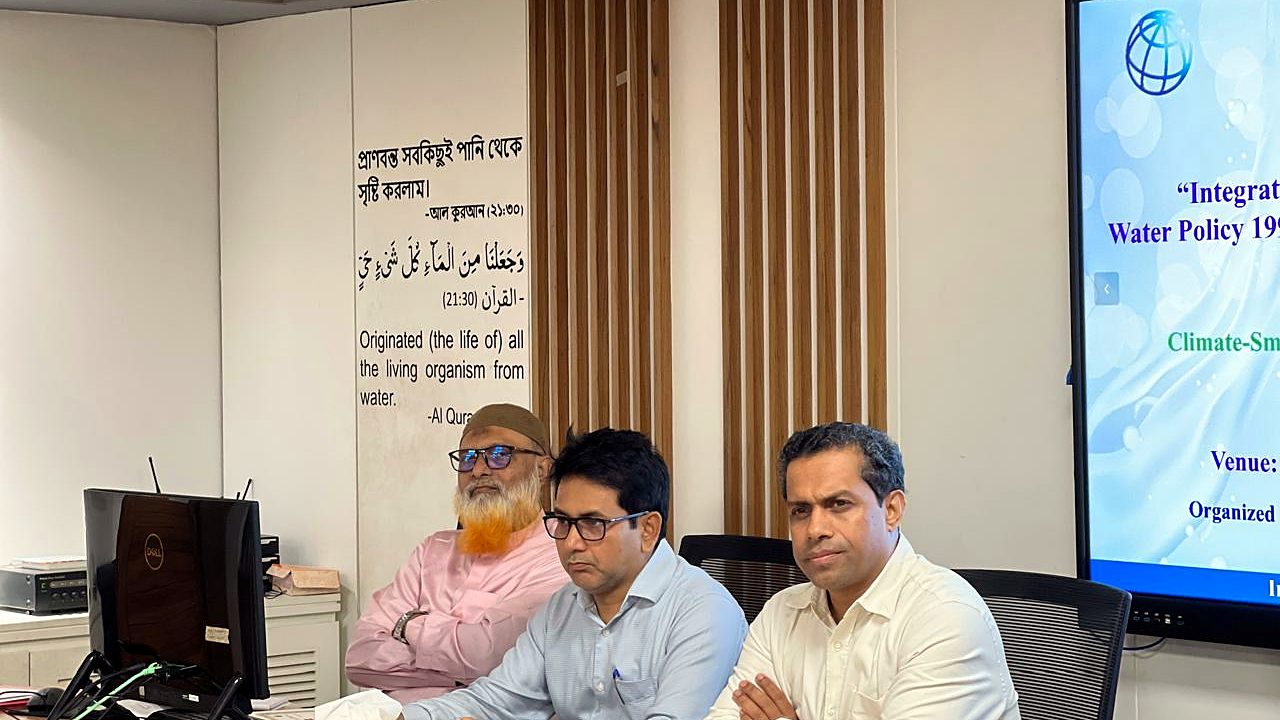
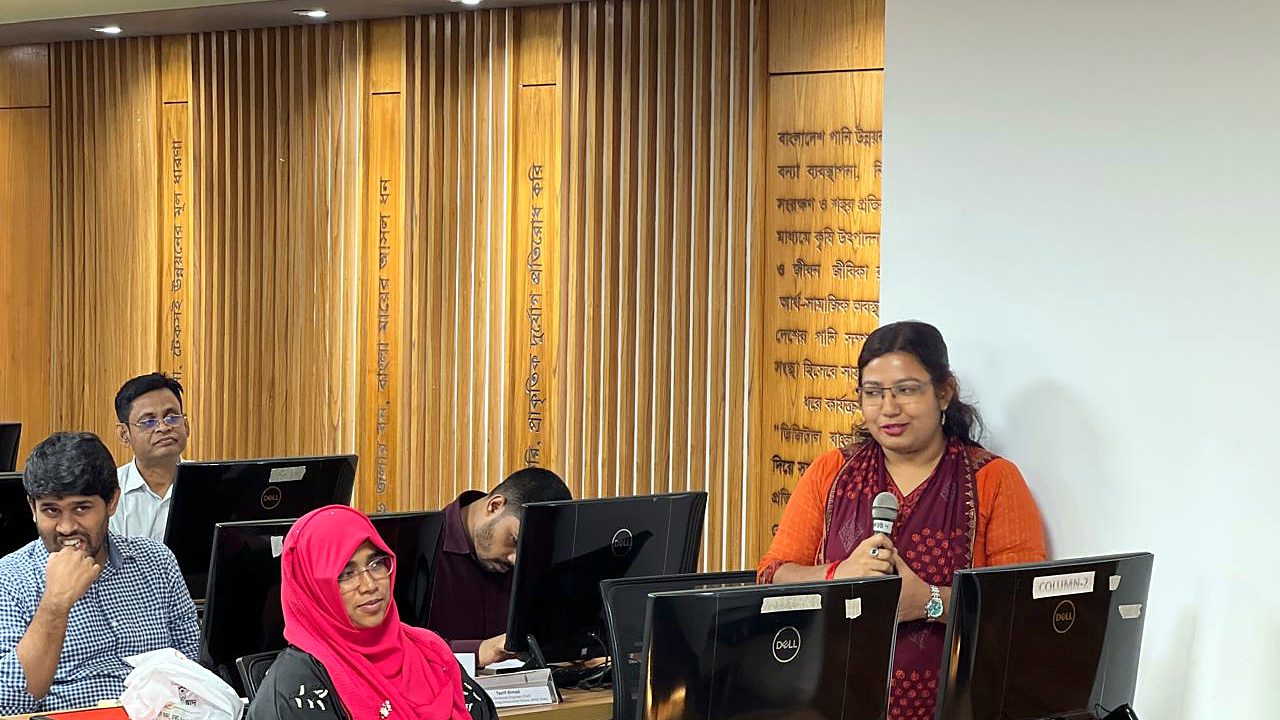
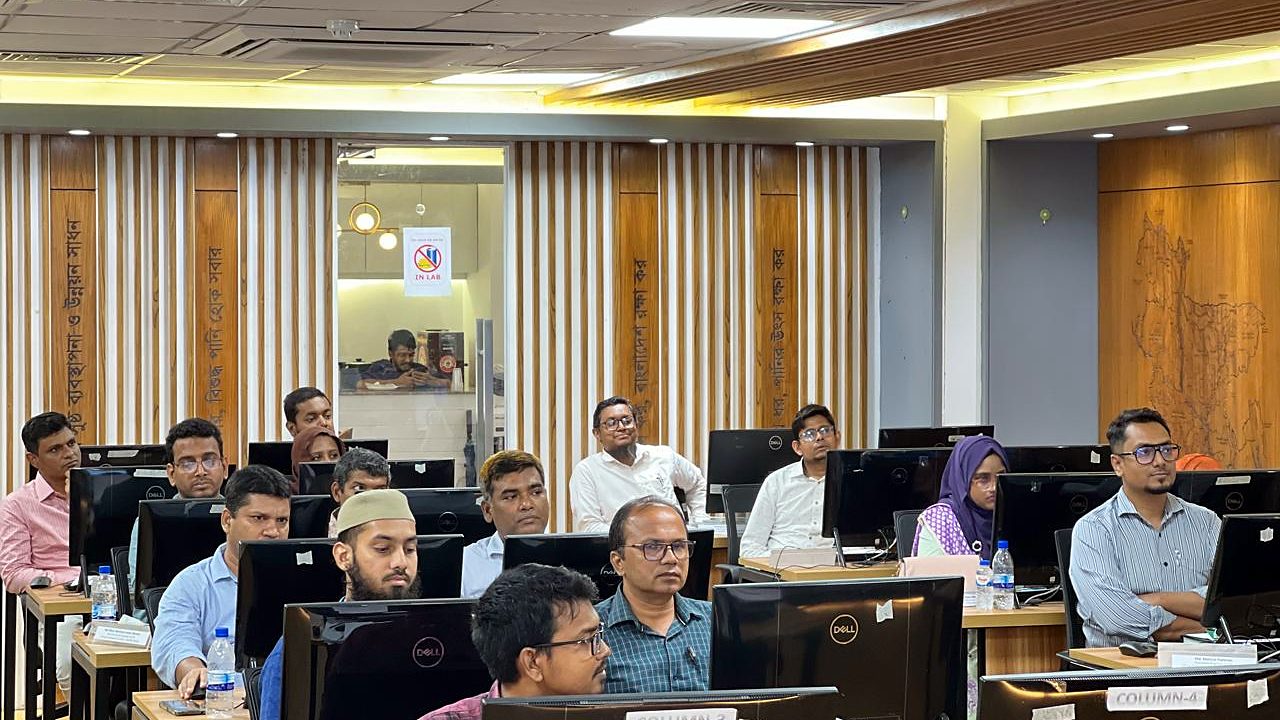
Sixteen further photographs from the three days at the Central ICT Lab, Pani Bhaban.
Why This Matters
Bangladesh’s water law is unusually complete on paper. The difficulty is that each instrument was written at a different time, for a different purpose, and a project engineer meets them one at a time — the policy at the concept stage, the participatory rules at handover, the Water Act when a licence or an inspection is due. Integrated Water Resources Management is, in practice, the habit of reading them together before the first drawing is made.
Running the course a second time, for a cohort led by Executive Engineers from the design circles, takes that habit to the point where it is cheapest to apply: before a scheme is designed rather than after it is built. Under the Climate-Smart Agriculture and Water Management Project, where every intervention has to balance agriculture, fisheries, flood control and the rights of water users, that is where integration has to start.
More from this Programme
Programme Snapshot
| Field | Detail |
|---|---|
| Course Title | Integrated Water Resources Management (IWRM) focuses on Water Policy 1999, Water Act 2013, and Water Resources Regulations 2018 |
| Reference | CSAWMP-WDB-PCU-WD-21-5-IWRM-02 — Package 21, Batch 5 |
| Duration | 3 days — 15 to 17 September 2026 |
| Venue | Central ICT Lab (Level-11), Pani Bhaban, BWDB, 72 Green Road, Dhaka-1205 |
| Participants | 25 officials of the Bangladesh Water Development Board |
| Ministry | Ministry of Water Resources, Government of the People’s Republic of Bangladesh |
| Implementing Agency | Bangladesh Water Development Board (BWDB) |
| Project | Climate-Smart Agriculture and Water Management Project (CSAWM Project), BWDB Part |
| Project Director | Pijush Krishna Kundu, Additional Chief Engineer (Civil) |
| Course Coordinator | Abdul Ahad, Executive Engineer (Civil), CSAWM Project (BWDB Part) |
| Sessions | 12 technical sessions across 3 days, four sessions per day |
| Resource Persons | 8 senior BWDB officials |
| Training Service Provider | Management and Training International Ltd. (MTI Ltd.) |
Frequently Asked Questions
What did the second IWRM course cover?
The principles and fundamentals of Integrated Water Resources Management, then Bangladesh’s water policy and law in sequence: the National Water Policy 1999, the National Water Management Plan 2001, the Guidelines for Participatory Water Management 2000, the Participatory Water Management Rules 2014, the BWDB Act 2000, participatory planning and stakeholder engagement, the Water Act 2013, and the Water Resources Regulations 2018 with the 2019 Guidelines, closing with integration, a case study and action planning.
How did this batch differ from the first IWRM batch?
Batch 1 was held at the BWDB Training Institute, Bhagyakul, Munshiganj, in June 2026. Batch 5 was held at the Central ICT Lab, Pani Bhaban, Dhaka, with a cohort led by six Executive Engineers, mostly from the design circles, and gave the final afternoon to a participant-led course review in place of the Bangladesh Delta Plan 2100 session that Batch 1 included.
Who were the resource persons?
Eight senior BWDB officials: Dr. Robin Kumar Biswas, Additional Chief Engineer, who taught IWRM principles, the Water Act and the Regulations; Dr. Md. Khairul Islam, Superintending Engineer, Planning-1; Deputy Chief Extension Officers Dr. Md. Zahidul Islam, Md. Hafizur Rahman and Muhammad Monirul Alam Sarker; Superintending Engineers Md. Sultan Mahmud and Abu Sale Mohammad Tofahel Chowdhury; and the Project Director, Pijush Krishna Kundu.
Where and when was the training held?
At the Central ICT Lab, Level-11, Pani Bhaban, 72 Green Road, Dhaka, from 15 to 17 September 2026.
Who funded and organised the course?
The course was funded by the Climate-Smart Agriculture and Water Management Project (CSAWM Project), BWDB Part, under the Bangladesh Water Development Board, Ministry of Water Resources. MTI Ltd. served as the training service provider under reference CSAWMP-WDB-PCU-WD-21-5-IWRM-02.
How many batches are planned under Package 21 and Package 22?
75 batches in total: 40 under Package 21 and 35 under Package 22. Seven of the Package 21 batches are IWRM courses; this was the second.